Balancing a Pole: From Q-Tables to Deep Q-Networks
Three agents learn to keep a pole upright on a moving cart. The first two store values in a table over a discretized state space; the third replaces the table with a neural network.
230
episodes for the DQN to solve
349
average over 100 test episodes
1,396
episodes, single Q-Learning
3,290
episodes, Double Q-Learning
Problem
Understanding the challenge and user needs
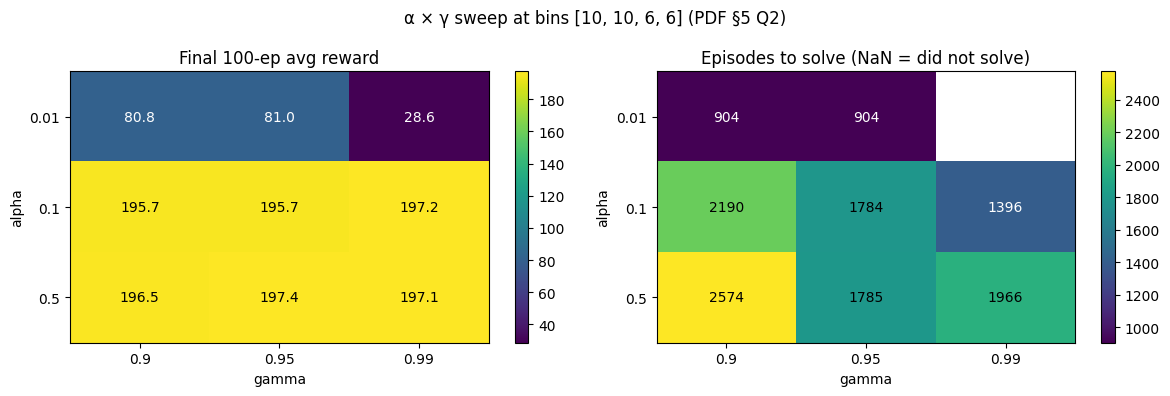
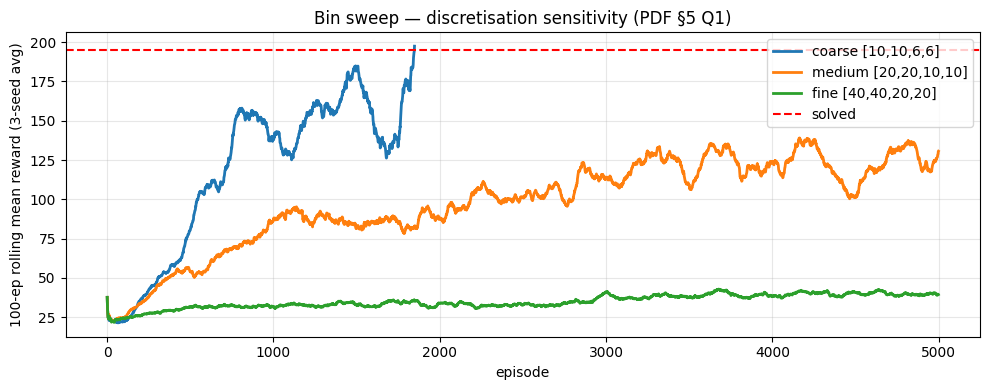
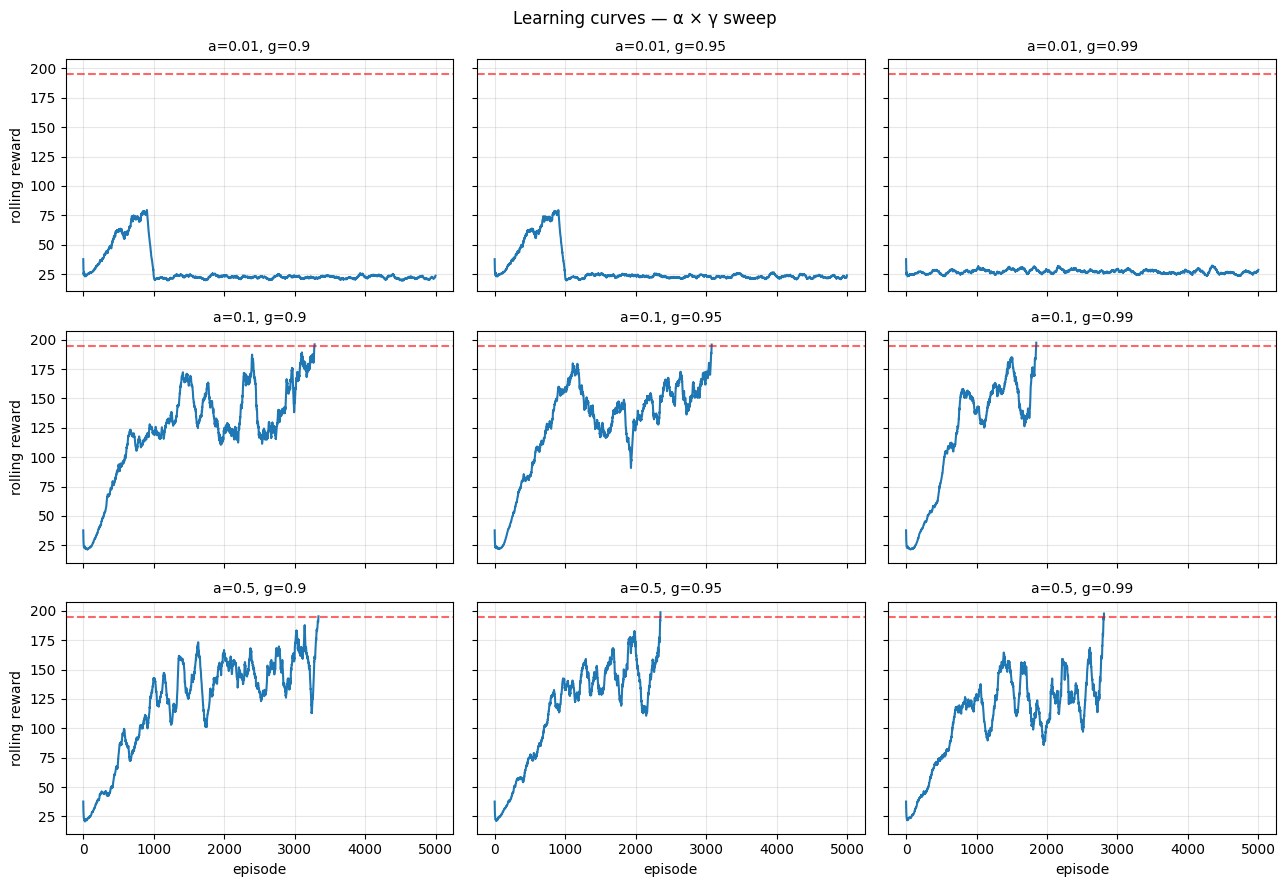
CartPole's state is continuous, so a table needs bins, and the choice of bins, learning rate, and discount decides whether the agent learns at all.
Approach
Strategy and methods used to address the problem
A sweep over learning rates and discount factors mapped which settings solve the task and how long each takes. Double Q-Learning tested whether two tables reduce overestimation, and a Deep Q-Network removed the bins entirely.
(opens in a new tab)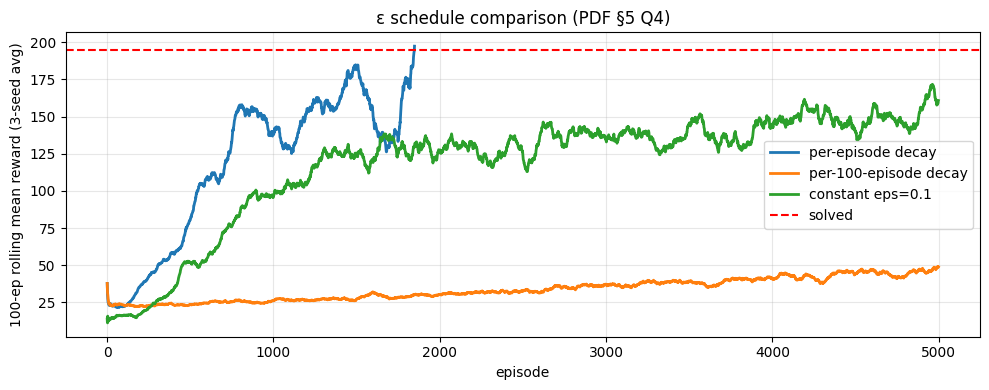
Final Solution
The final design and outcome
The Deep Q-Network solved the task at episode 230 and averaged 349 points over 100 greedy evaluation episodes. Double Q-Learning needed 3,290 episodes on average against 1,396 for single Q-Learning.
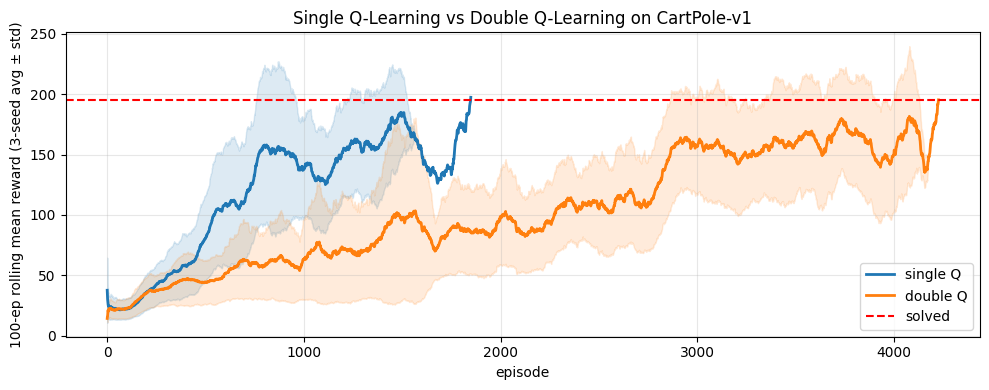
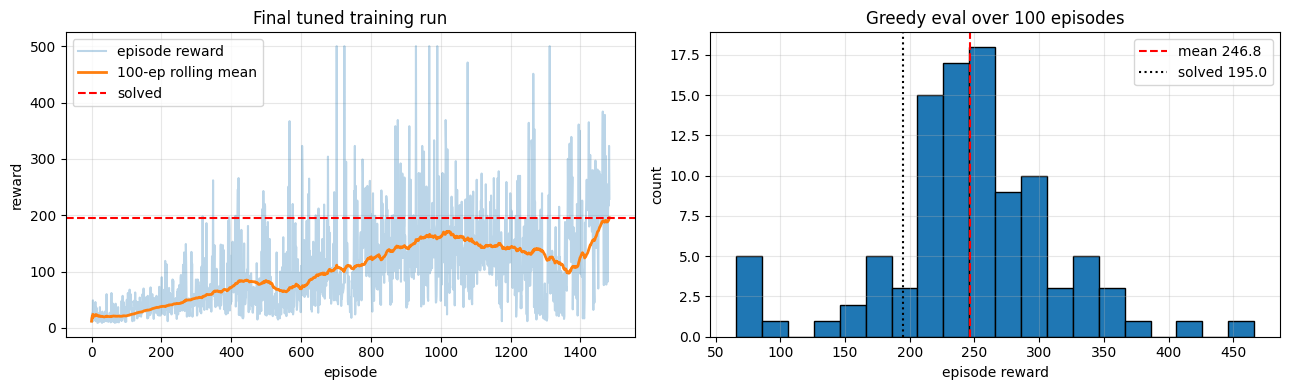
Episodes needed to solve the task
| Agent | Episodes to solve |
|---|---|
| Deep Q-Network | 230 |
| Tabular Q-Learning | 1,396 plus or minus 404 |
| Tabular Double Q-Learning | 3,290 plus or minus 1,220 |
The final DQN averaged 349.10 plus or minus 21.77 over 100 greedy episodes.
Impact & Validation
Results, learnings, and outcomes
The more careful estimator learned more slowly here, a reminder that a fix for one failure carries a cost of its own.