Teaching Robots to Walk: PPO and Imitation Learning
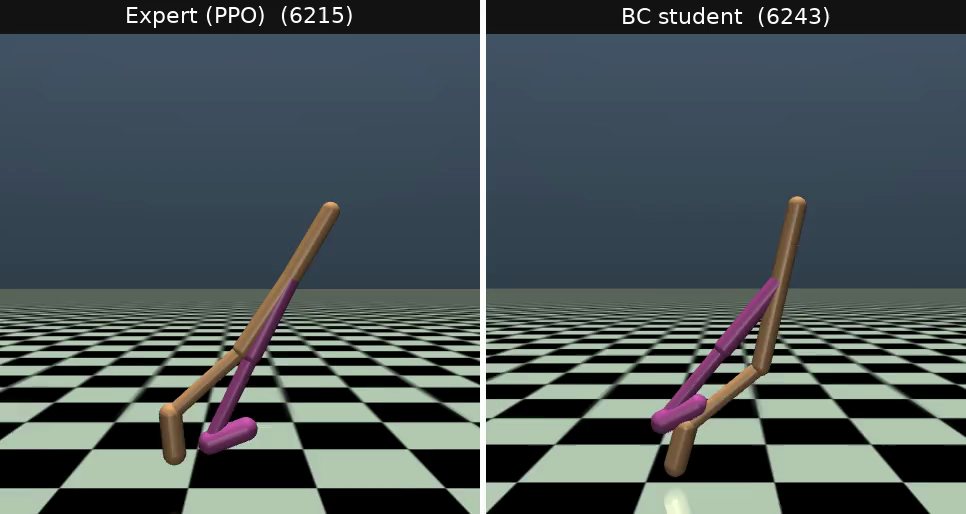
Two simulated robots, a two-legged walker and a four-legged ant, learn to move in the MuJoCo physics engine. A PPO expert learns each task from scratch, behavioral cloning and DAgger distil the expert into a student, and the student then continues training on its own.
6,208
DAgger student on the walker
6,043
its PPO teacher
4.0x
gain from normalizing observations
Problem
Understanding the challenge and user needs
Reinforcement learning from scratch spends millions of steps rediscovering how to stand. Imitation offers a shortcut, but a student that only copies demonstrations fails as soon as it drifts into situations the expert never showed it.
Approach
Strategy and methods used to address the problem
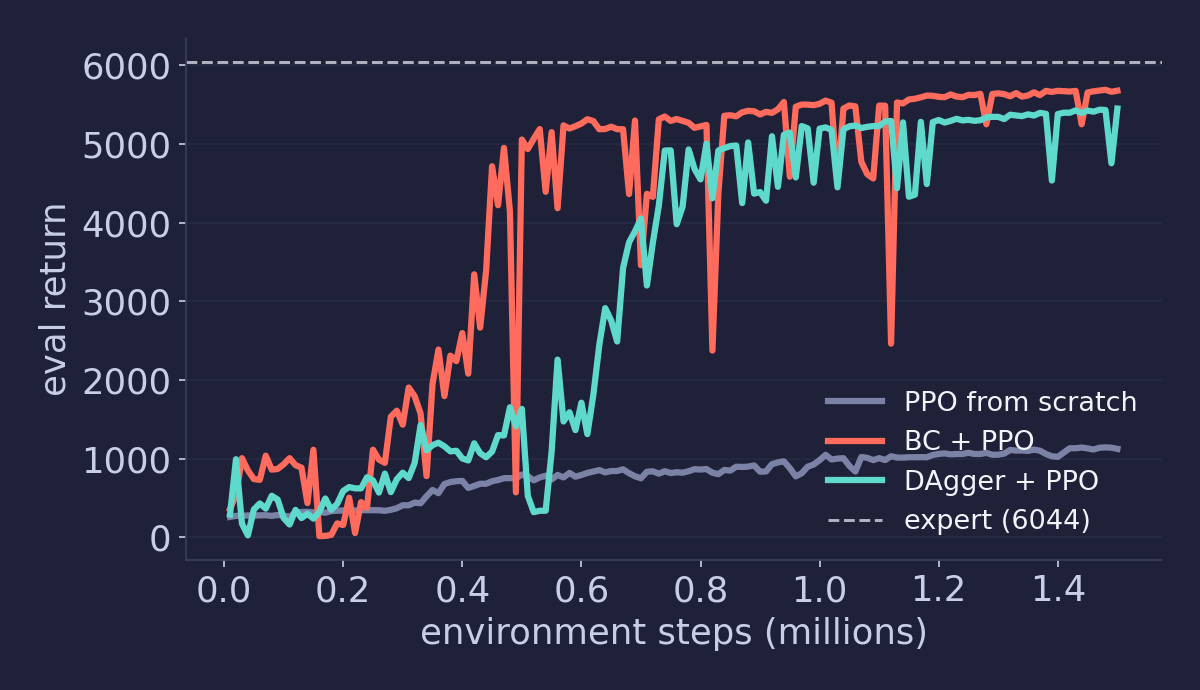
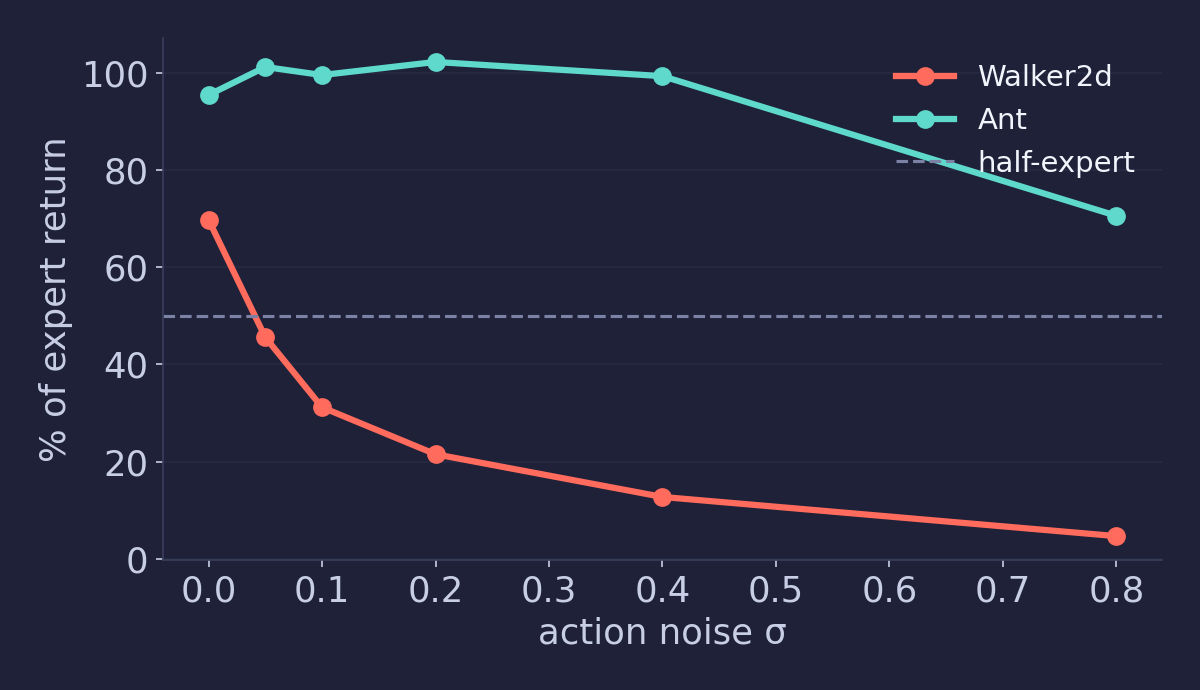
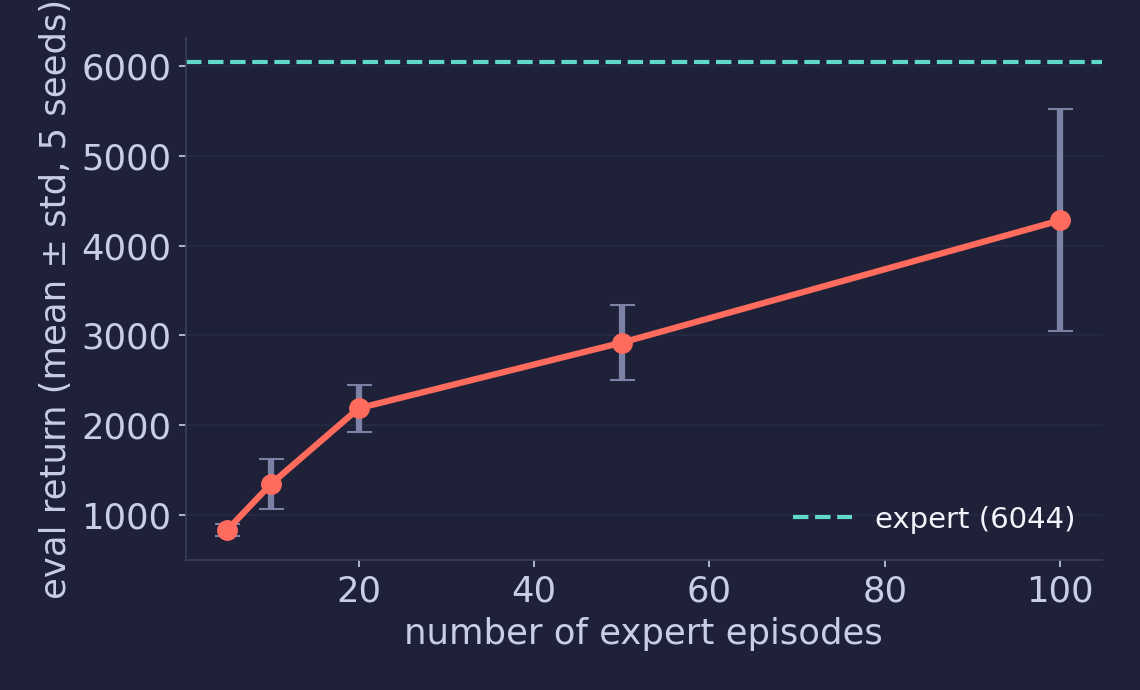
A five-person team trained PPO experts for 8 million and 10 million steps, cloned them with behavioral cloning and with DAgger, and then used each clone as a warm start for further PPO training. Ablations isolated noisy experts and observation normalization, and an off-policy SAC expert provided a second reference.
(opens in a new tab)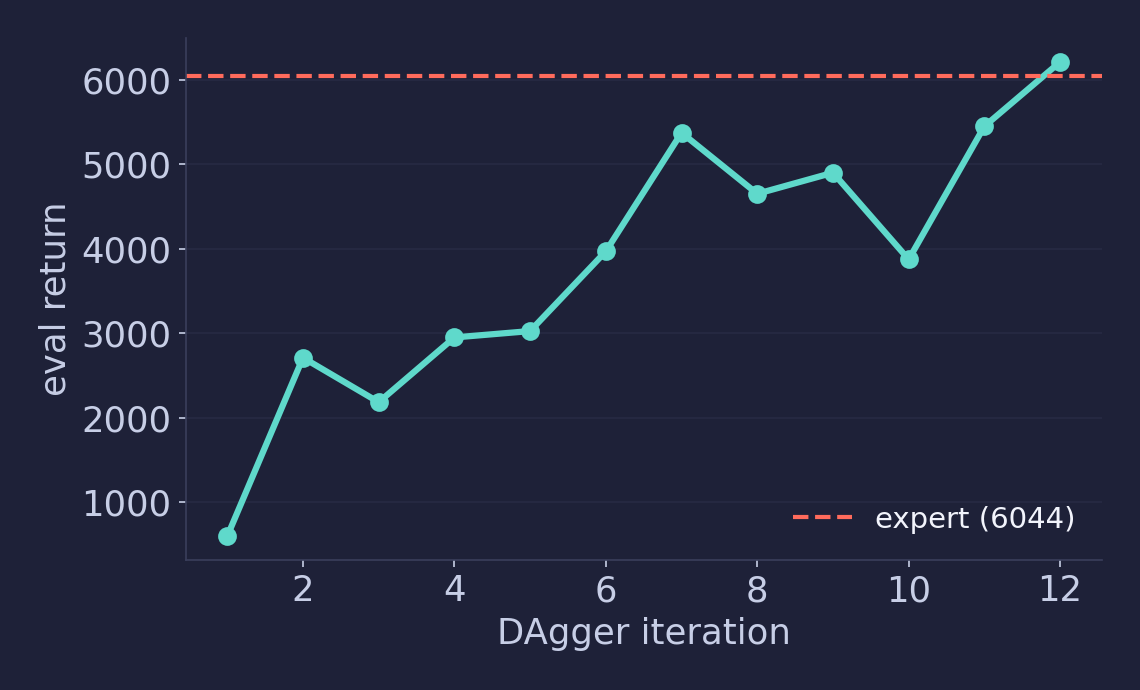
Final Solution
The final design and outcome
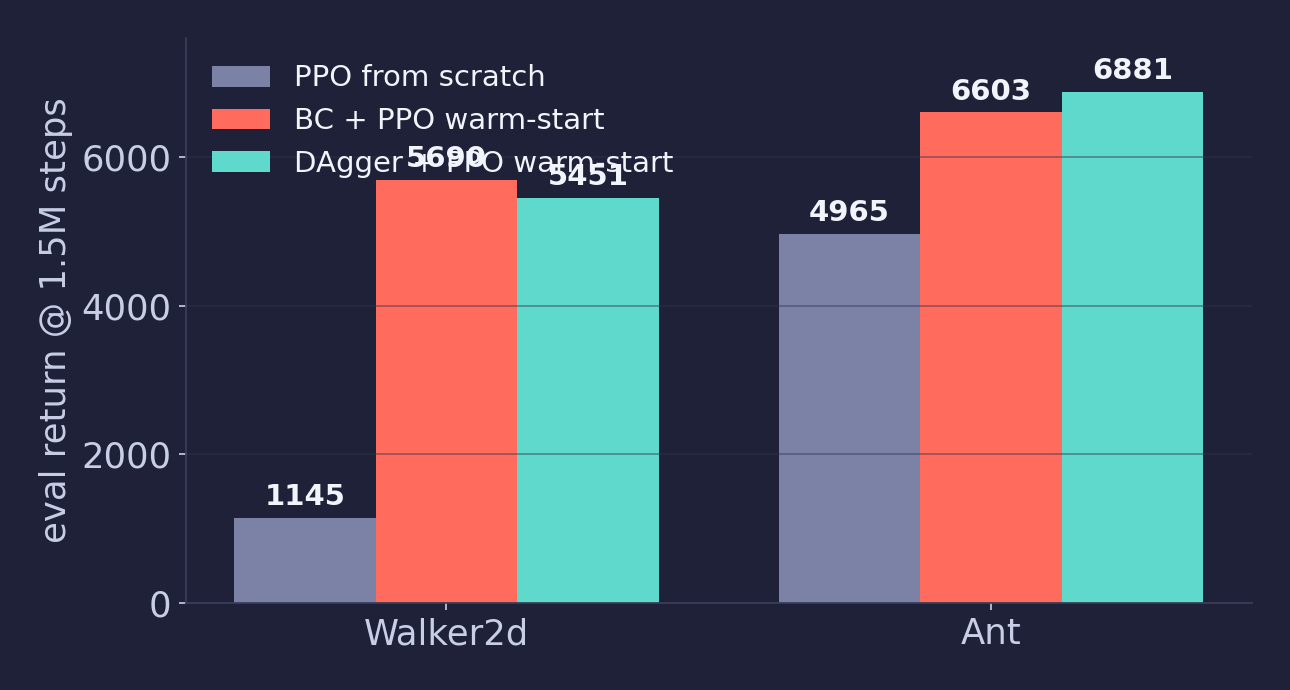
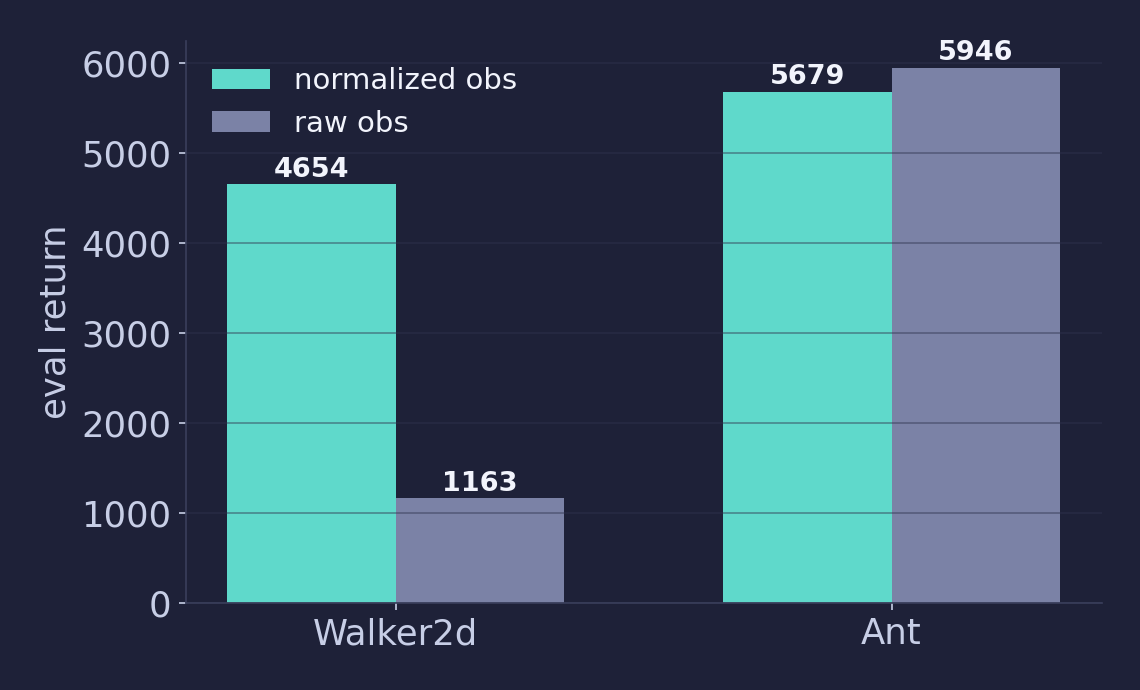
DAgger students matched or exceeded their teachers: 6,208 against 6,043 on the walker and 6,564 against 6,293 on the ant. After 1.5 million steps, a warm-started walker scored about 5,700 where the same algorithm from scratch scored about 1,126. Observation normalization alone changed the walker's return fourfold.
 (opens in a new tab)
Average return over 20 evaluation episodes
| Experiment | Walker2d | Ant |
|---|---|---|
| PPO expert | 6,043 | 6,293 |
| Behavioral cloning | 5,719 (95%) | 6,237 (99%) |
| DAgger | 6,208 | 6,564 |
| PPO from scratch at 1.5M steps | about 1,126 | about 4,965 |
| Imitation then PPO at 1.5M steps | about 5,700 | 6,600 to 6,900 |
| Cloning with and without normalized observations | 4,654 and 1,163 | 5,679 and 5,946 |
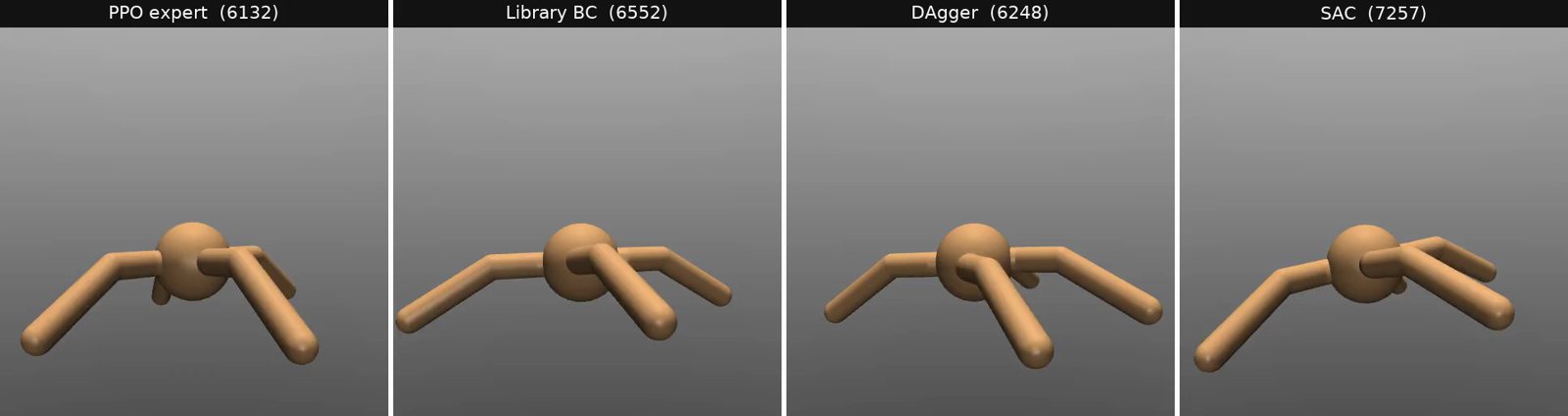
A SAC expert reached 7,295 on the ant in 3 million steps against PPO's 6,293 in 10 million.
Impact & Validation
Results, learnings, and outcomes
The results give a practical rule for training budgets: demonstrations buy most of the performance for a fraction of the steps, and the remaining steps are better spent refining than rediscovering.
Presentation
The deck, slide by slide

Slide 1 of 30