The Safe Path and the Short Path: SARSA and Q-Learning
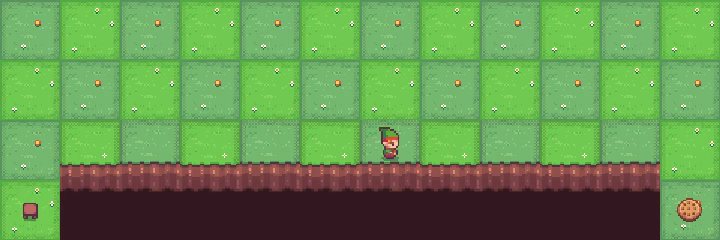
SARSA and Q-Learning learn the same two tasks: delivering a taxi passenger and walking along a cliff edge. The update rules differ in a single term, and that term changes how each agent treats risk.
17
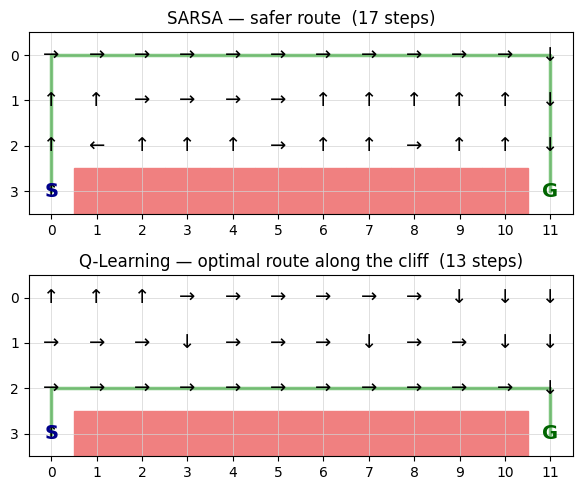
steps on SARSA's safe route
13
steps on Q-Learning's route
-24.6
SARSA training reward
-53.1
Q-Learning training reward
Problem
Understanding the challenge and user needs
An agent that explores will sometimes step off the cliff. Whether its learning accounts for those missteps determines the route it prefers.
Approach
Strategy and methods used to address the problem
Both agents trained on Taxi and Cliff Walking, with rolling training reward and greedy evaluation recorded for each.
Final Solution
The final design and outcome
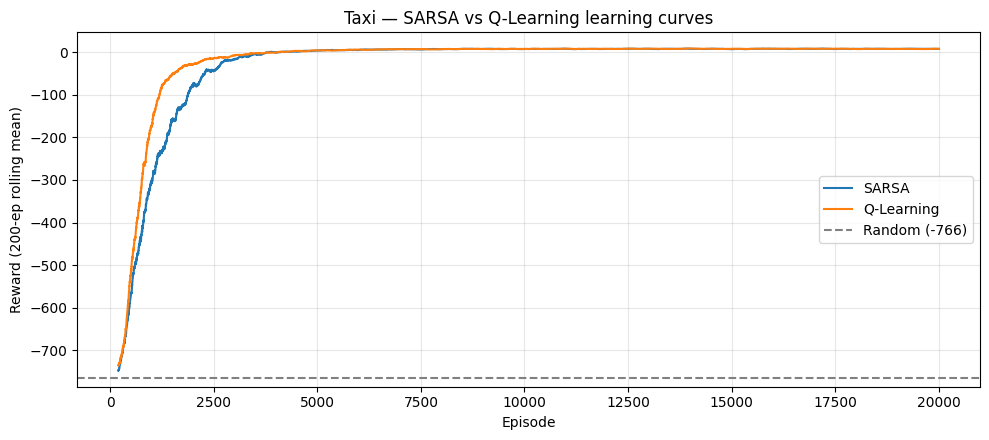
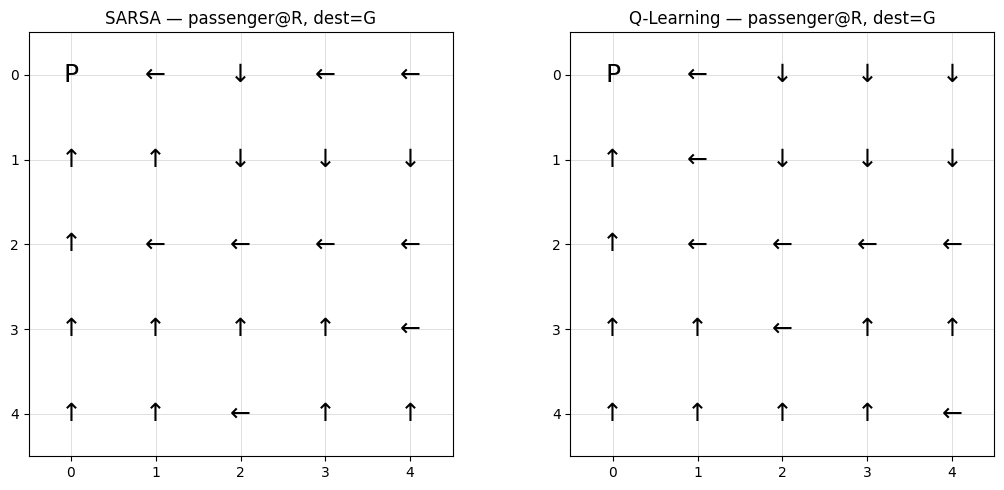
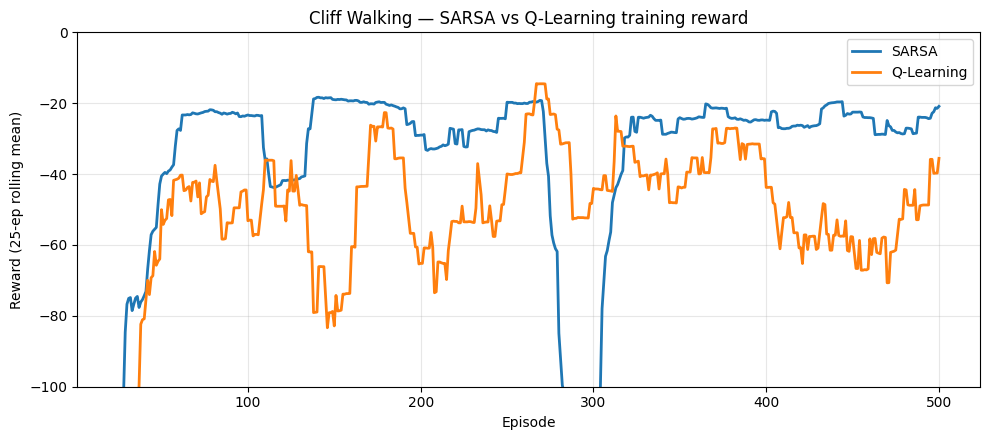
On Taxi the two finished close together, 7.89 for SARSA and 8.14 for Q-Learning against negative 765 for random play. On the cliff, SARSA averaged negative 24.6 over its last 100 training episodes while Q-Learning averaged negative 53.1.
 (opens in a new tab)
Two tasks, two agents
| Task and measure | SARSA | Q-Learning |
|---|---|---|
| Taxi, greedy evaluation reward | 7.89 | 8.14 |
| Cliff Walking, last 100 training episodes | -24.6 | -53.1 |
| Cliff Walking, length of learned route | 17 steps | 13 steps |
Random play on Taxi averages -765.
Impact & Validation
Results, learnings, and outcomes
Q-Learning learns the shortest route and pays for it while exploring; SARSA learns the route that survives its own mistakes. The right choice depends on whether errors during learning cost anything.