Spam or Ham: An Email Classifier
A classifier labels each email as spam or legitimate. The training set holds 4,171 emails, 1,200 spam and 2,971 legitimate, with 1,000 more for testing.
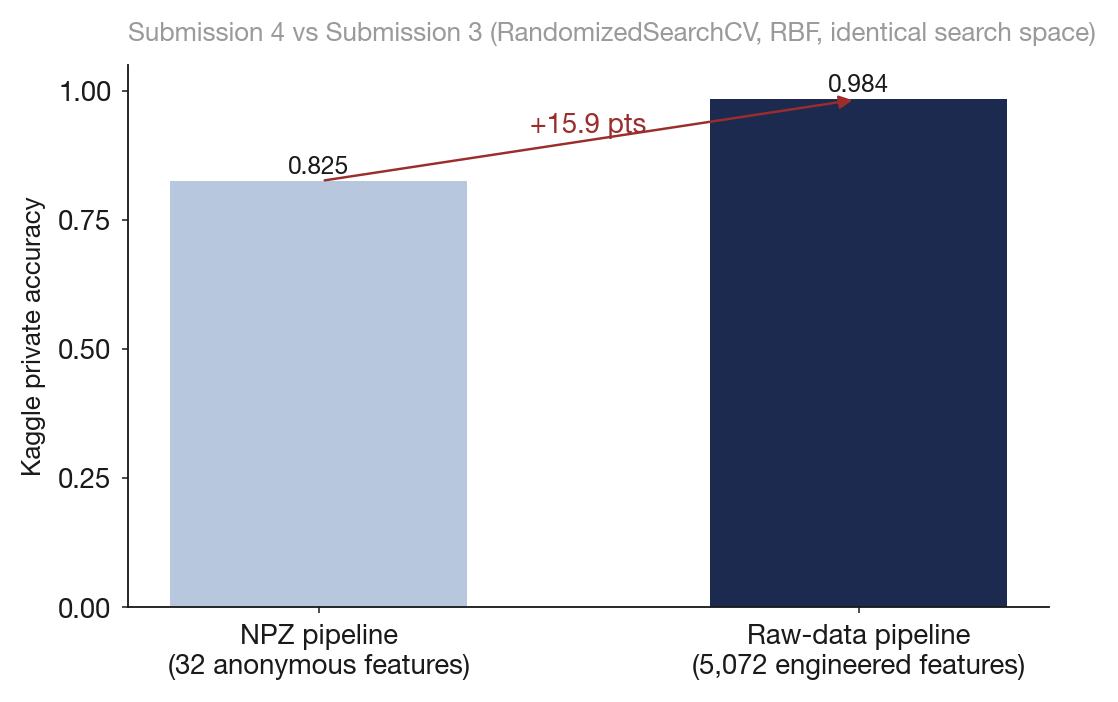
0.984
Kaggle private accuracy
4,171
training emails
5,072
engineered features
+15.9
points over pre-built features
Problem
Understanding the challenge and user needs
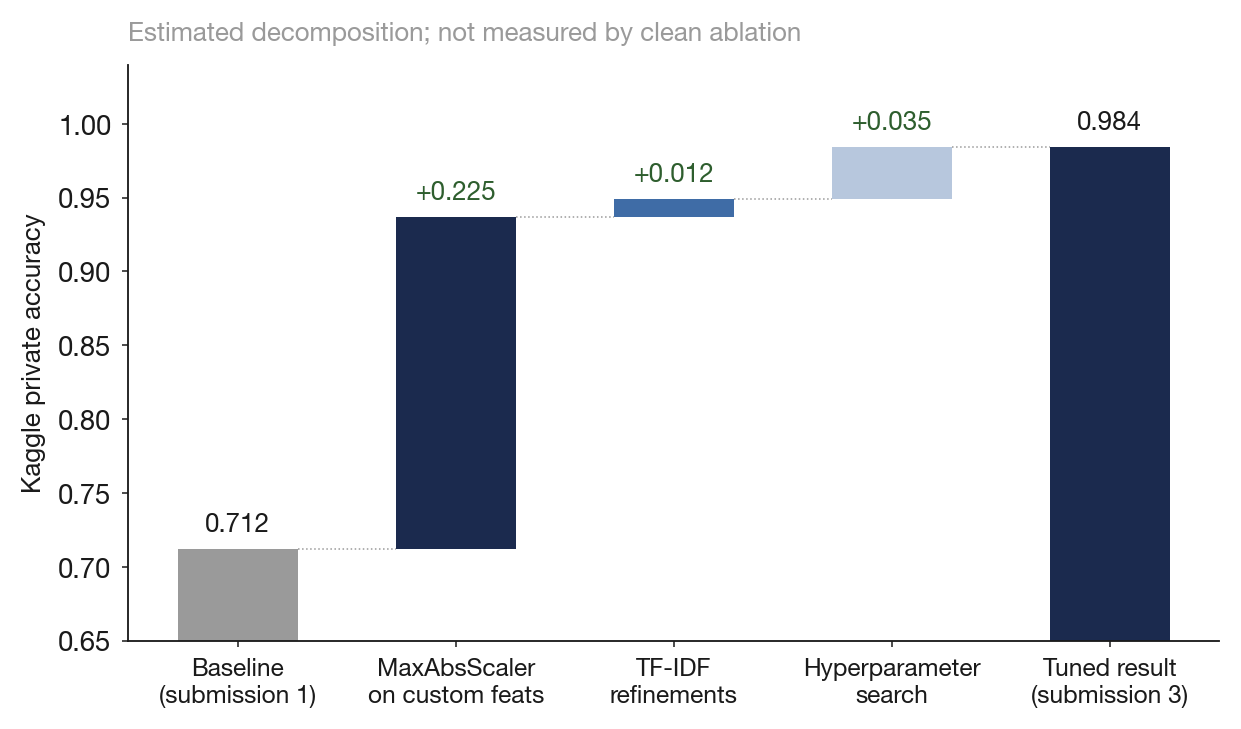
Labeling every email legitimate already scores 71 percent, so accuracy alone flatters a weak model. Word counts alone miss part of the signal, so the features have to describe how an email reads as well as what it says.
Approach
Strategy and methods used to address the problem
Feature engineering combined 5,000 TF-IDF terms with 72 hand-built signals for a total of 5,072 features. Cross-validation tuned the kernel and regularization strength of a support vector machine.
Final Solution
The final design and outcome
An RBF-kernel SVM scored 98.4 percent on Kaggle's private leaderboard, against 82.5 percent for the same search on the 32 pre-built features the competition supplied.
(opens in a new tab)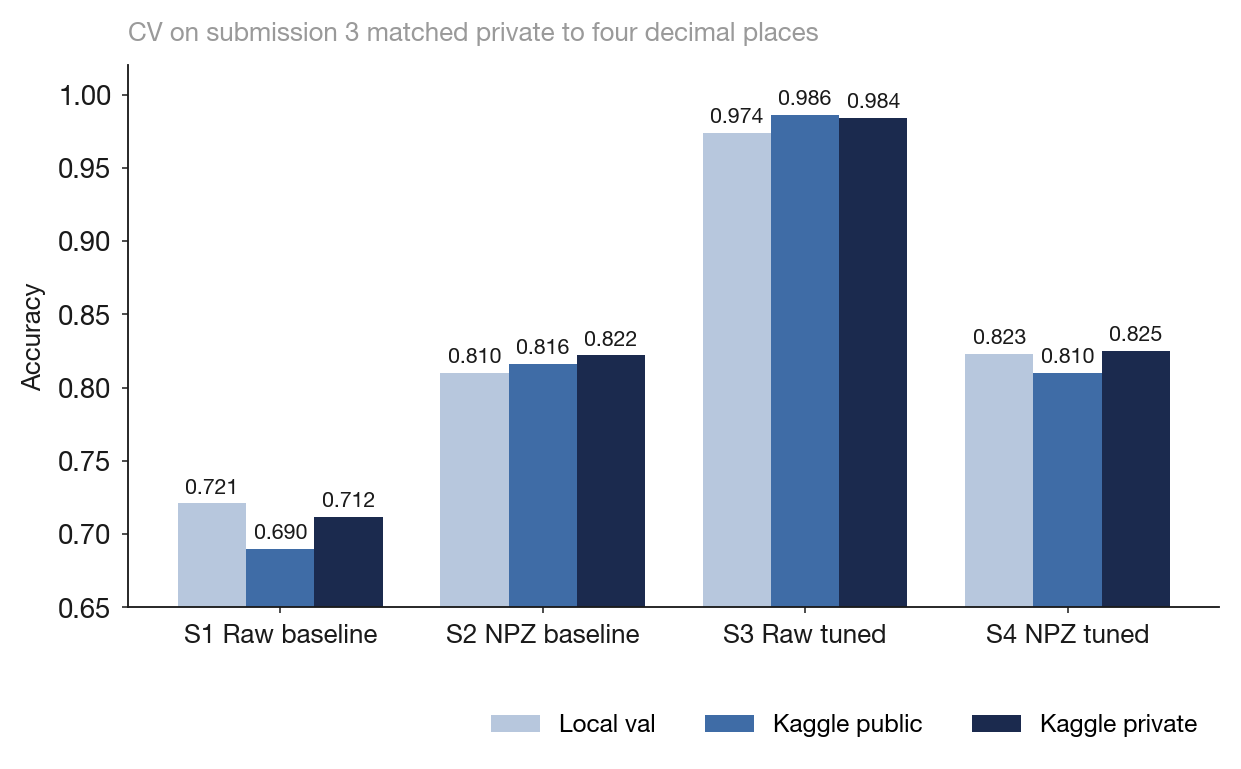
Four submissions, three scores each
| Submission | Local validation | Kaggle public | Kaggle private |
|---|---|---|---|
| Raw emails, baseline | 0.721 | 0.690 | 0.712 |
| Pre-built features, baseline | 0.810 | 0.816 | 0.822 |
| Raw emails, tuned | 0.974 | 0.986 | 0.984 |
| Pre-built features, tuned | 0.823 | 0.810 | 0.825 |
The pre-built set holds 32 anonymous features; the raw pipeline builds 5,072.
Impact & Validation
Results, learnings, and outcomes
The sixteen-point gap came from the features, not the algorithm, which makes the case for understanding the data before tuning the model.